
From Website Form to Closed Deal: Building an Automated Lead Pipeline Without a Sales Team
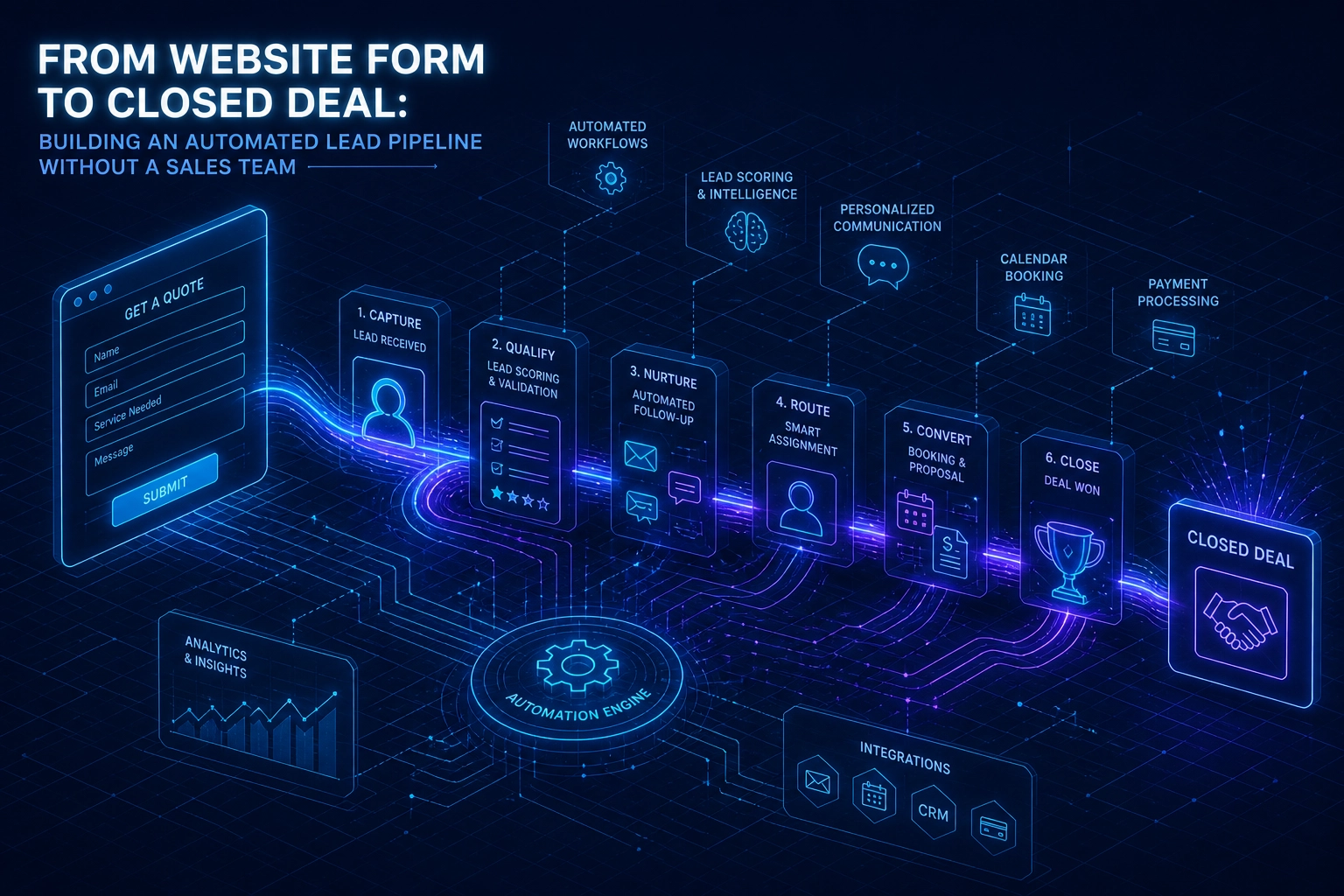
Every time a promising lead lands in your inbox and sits there unanswered for 48 hours, you are losing money. For solo founders and small UK service businesses, the gap between a website form submission and a closed deal is rarely a strategy problem. It is a capacity problem. There simply are not enough hours to manually qualify, follow up, enrich, and nurture every enquiry that comes through.
Here is the reality: you do not need a sales team to fix this. You need a properly architected lead generation pipeline that does the work for you.
This guide walks you through a six-stage automated system that takes a prospect from initial form submission through to a signed proposal, without a single salesperson involved. You will learn how to build qualifying forms, automate lead scoring, trigger personalised follow-up sequences, and receive notifications only when a lead is genuinely ready to buy. The architecture covered here is practical, UK GDPR compliant, and deployable today using tools that are already on the market. If you run a service business and you are handling leads manually, this is the workflow that changes that.
Why Manual Lead Handling Kills Small Service Businesses
Solo founders and small UK service business owners routinely lose significant hours each week to tasks that produce no billable output: qualifying inbound enquiries, chasing follow-ups, and manually entering contact data into a CRM. Across a year, that time represents weeks of capacity redirected away from delivery and growth.
Manual B2B lead generation also introduces structural inconsistency. Response times depend on when the founder checks their inbox. Follow-up sequences get abandoned after one or two touches. CRM records stay incomplete because data entry happens reactively, if at all.
Hiring to solve this is expensive before it is justified. A dedicated salesperson in the UK carries a substantial annual cost once salary, employer National Insurance, and onboarding are included. Most small service businesses cannot absorb that overhead before they have consistent pipeline volume, which creates a circular problem: you need pipeline to afford sales help, and you need sales help to build pipeline.
The sharpest competitive disadvantage is speed. Manual processes routinely miss the narrow window when inbound intent is highest. The impact on your hiring workflow shows how broadly this speed problem extends beyond lead handling alone.
The automation stack available in 2026 removes the dependency on human speed entirely. A well-architected lead generation funnel can qualify, enrich, nurture, and escalate without manual intervention until a prospect is genuinely ready to engage.
The Six-Stage Automated Lead Pipeline Architecture
The pipeline that eliminates your sales headcount runs across six discrete stages. Each stage has a single job, and each hands off cleanly to the next without human involvement.
Stage 1: Capture. A form submission fires the trigger for everything downstream. The form must collect qualification signals, not just contact details: budget band, service type, timeline, and company size. Without these structured inputs, every subsequent stage breaks.
Stage 2: Qualification. Automated scoring logic evaluates each response against your ideal customer profile, assigning the lead a tier (hot, warm, or cold) without anyone reading the submission. Research confirms that lead scoring is a measurably effective tool for determining lead quality, and the three-tier model maps directly to the branching logic your automation layer will execute.
Stage 3: Enrichment. The moment a CRM record is created, a webhook fires to an enrichment tool, populating company size, industry, LinkedIn profile, and firmographic data automatically. The record is complete before any follow-up is sent, enabling genuine personalisation rather than mail-merged templates. This mirrors the four steps from raw data to insights that separate useful pipeline data from noise.
Stage 4: Personalised Follow-Up. Hot leads receive an email within minutes, including a direct booking link. Warm leads enter a multi-touch nurture track. Cold leads enter a long-term educational sequence, with re-scoring triggered by engagement events.
Stage 5: Proposal Trigger. When a completed discovery call is logged, a conditional automation populates a proposal template with the prospect's submitted details and sends it within a defined window, closing a gap that typically costs days of momentum.
Stage 6: Owner Notification. The founder receives one consolidated alert only when a lead has qualified, completed a call, and received a proposal. Unqualified enquiries never surface.
This entire crm lead generation architecture runs natively on modern platforms for most service business use cases, though complex configurations may require development work.
Stage 1: Designing a Form That Does the Qualifying For You
The architecture above is only as good as the data entering it. That data comes entirely from your form, making form design the most consequential decision in the pipeline.
A basic contact form collecting name, email, and message defers qualification to whoever reads the inbox, leaving every follow-up step as manual work the automation is supposed to eliminate.
Build for structured output, not readability
Use conditional logic to surface the right questions at the right moment. A prospect selecting "SEO retainer" should see different follow-ups than one selecting "automation consultancy." Dropdown fields for budget bands (under £3k, £3k–£7k, £7k+) and timeline produce structured values a scoring workflow can evaluate numerically. A free-text field cannot be scored automatically; a dropdown can.
Company name is not optional. It is the key that unlocks enrichment in Stage 3. Without it, the downstream record is incomplete before the prospect has left your site.
Map every field to a score before you build
Each field should have a defined point value before a single question is written. If decision-maker status is worth 25 points, the form must capture it as a selectable field, not infer it from a message.
Split into steps to protect completion rates
Break qualification questions across two or three steps with a visible progress indicator. Eight fields on one page increases abandonment; a short sequence reduces friction without removing depth.
GDPR consent is non-negotiable
Under ICO guidance on direct marketing, marketing communications require explicit, separate opt-in consent distinct from the service enquiry. A single checkbox covering both is not compliant. The marketing consent checkbox must be unticked by default and written in plain language. The enquiry can be processed under contract pre-performance; the follow-up sequence cannot.
Output to structured CRM fields, not an email notification
Tools such as Typeform, Tally, or a native CRM form builder handle conditional logic without development work. Each field must submit to a named, structured CRM property. If the form sends a formatted email to your inbox instead, the entire downstream automation breaks. From form submission to complete documentation illustrates how structured form output connects directly to automated record creation and document generation without manual intervention.
Stage 2: Building an Automated Lead Scoring System
With your form outputting structured, scored fields into the CRM, the next step is building the logic that converts those raw field values into a lead tier automatically.
The discipline is in defining the right variables before you build anything.
Start with your ideal customer profile. Identify the three to five variables that most reliably predict a closed deal. For UK service businesses, those are typically budget fit, decision-maker status, timeline urgency, and service alignment.
The following is an illustrative example, your thresholds should be calibrated against your own win-loss data.
Criterion | Points |
|---|---|
Budget over £5,000 | 30 |
Decision-maker role confirmed | 25 |
Timeline under three months | 25 |
Relevant service selected | 20 |
Above 70 triggers the hot lead sequence. Between 40 and 70 enters the warm nurture track. Below 40 goes to the long-term educational sequence.
Most CRM platforms handle rule-based scoring natively. Workflow automation tools add a further layer: scoring can respond to post-submission behaviour such as email opens, page visits, and link clicks, incrementing a lead's score and potentially elevating them from warm to hot without manual intervention.
As of 2026, AI-driven qualification is increasingly available within CRM platforms. These tools evaluate unstructured free-text responses and assign probability scores based on historical deal patterns, useful when a prospect's budget or timeline answer is vague.
Review your scoring thresholds quarterly. If hot leads consistently fail to convert, the threshold is too low. If the hot pipeline is sparse, your qualification criteria may be too strict. The model should evolve as your win-loss data accumulates.
Stage 3: Automatic Lead Enrichment and CRM Record Creation
Once the scoring model assigns a tier, enrichment runs automatically, filling in everything the prospect did not tell you.
A form submission typically yields a name, email, company name, and a handful of qualification responses. Enrichment automation resolves the gaps by connecting to the submission event via webhook and returning structured data to the CRM before any follow-up email is triggered.
Fields populated at this stage typically include company size, industry vertical, LinkedIn URL, estimated annual revenue, and website technology stack. Each field becomes a personalisation token available to the follow-up sequence in Stage 4. An automated email referencing a prospect's specific industry and company name outperforms a generic template; the recipient perceives relevance rather than a broadcast.
The practical decision is whether to use native CRM enrichment or connect a third-party tool via your workflow automation layer. Native enrichment is faster to configure; third-party tools typically offer higher match rates and more granular data fields.
For UK service businesses targeting SMEs, one enrichment source deserves specific attention: the Companies House API. Check the current Companies House API documentation for available fields and access terms. A company incorporated six months ago with no director history warrants different handling than an established trading business. This data point alone can prevent wasted proposal effort on illegitimate enquiries.
Every subsequent stage reads from and writes to the CRM record created here. Treat it as the single source of truth: if a field is missing, every downstream personalisation and conditional trigger that depends on it will fail silently. You can see how this architecture operates in practice across the Featured Projects Automation by Meir has delivered for UK service businesses.
Stage 4: Tier-Specific Follow-Up Sequences That Close Without You
With the enriched CRM record in place, the pipeline has everything it needs to communicate intelligently. What happens next determines whether a lead converts or quietly disappears, because manual follow-up is inconsistent: one email goes out, a second gets forgotten, and a warm prospect books with a competitor who responded faster.
The sequence lengths below are illustrative starting points; adjust based on your audience's engagement data.
Hot leads (above scoring threshold): An automated email fires as soon as possible after form submission, ideally within minutes. It acknowledges receipt, references the prospect's submitted challenge by name using CRM personalisation tokens, and includes a direct calendar booking link. No pitch, no friction, just an immediate response at the moment intent is highest.
Warm leads (mid-range score): These prospects enter a five-to-seven touch sequence over 14 days. Each email delivers something useful before requesting a meeting: a relevant case study, a short methodology video, a diagnostic checklist. Each subsequent email triggers only if no booking has been made. The sequence stops the moment they convert.
Cold leads (below threshold): A nurture track of eight to twelve emails over 60 to 90 days keeps the relationship warm with educational content. When a cold lead opens an email or clicks a link, that engagement triggers a score increment. Sufficient engagement elevates them automatically into the warm sequence, without manual review.
All three sequences must include a one-click unsubscribe mechanism that processes opt-outs immediately, as required under PECR. Honouring it promptly also protects sender reputation and deliverability.
Personalisation tokens pulled from the enriched CRM record, including company name, service interest, and the specific challenge the prospect described, transform templated sequences into communications that feel individually researched. That specificity separates sequences that generate replies from those that generate unsubscribes.
Stage 5: Automating the Proposal After the Discovery Call
The follow-up sequence gets a prospect to the discovery call. The proposal stage is where many solo founders quietly hand back control to the calendar.
The typical pattern: the call goes well, the prospect is engaged, and then days can pass while the proposal is drafted manually. By the time it lands in their inbox, competing options have been considered and momentum has stalled. The fix is a trigger, not a template.
How the trigger works
When the discovery call is marked as completed in the CRM or calendar integration, a workflow fires automatically. It reads the prospect's CRM record and pulls company name, service interest, budget band, and any notes captured by an AI meeting summary tool connected to the call. That data populates the relevant proposal template within minutes of the call ending, and the formatted document is sent directly to the prospect's email address without any manual input.
Conditional routing for different service lines
The trigger reads the service field from the CRM record and routes to the correct template. A web project proposal carries different scope structure and pricing logic than a retained consultancy engagement. One workflow, two outputs, zero manual decisions required.
Closing the loop at the proposal stage
The proposal itself should include an embedded e-signature link or a deposit payment link. This removes the need for any follow-up chasing; the prospect can commit directly from the document.
Engagement tracking completes the picture. If a prospect opens the proposal repeatedly without signing, that behaviour writes back to the CRM record and triggers a notification task for you. It is a clear buying signal, and to understand how this fits the broader approach to building client relationships, that handoff from automation to human is where the architecture is designed to land.
Stage 6: Notifying the Owner Only When It Matters
Proposal engagement tracking feeds directly into this final stage. Once the proposal is in the prospect's hands, the pipeline's job is to tell you exactly when to step in, and nothing more.
The real value of a fully automated lead generation pipeline is not the hours recovered; it is the mental overhead eliminated. The goal is to surface only the prospects who have qualified, engaged, and received a proposal.
The specific trigger values below are configurable starting points, not universal standards; set them based on your typical sales cycle.
Trigger conditions for owner notification:
Proposal opened more than twice without a signature
E-signature completed
Payment or deposit link clicked
A warm lead requests a call outside the automated booking flow
Each condition signals genuine purchase intent. Anything below that threshold stays inside the automation.
Notifications should be consolidated and contextual. A raw CRM alert is noise. A structured Slack message, email, or SMS containing the prospect's name, company, lead tier, call notes summary, and current proposal status is actionable in under a minute. That is the format to build.
Escalation triggers handle the gaps. If a hot lead has not booked a call within 48 hours of entering the sequence, flag it for personal outreach. If a proposal has been open for seven days without a signature, create a check-in task automatically. Both rules live in the workflow layer alongside the rest of the pipeline logic.
For UK founders who are frequently on-site or client-facing, mobile-first CRM interfaces mean reviewing, responding to, and updating a record takes minutes from a phone rather than requiring a return to the desk.
This stage closes the loop between the automated lead generation funnel and the human relationship layer. Automation handles volume and consistency across every earlier stage; the founder engages only when a qualified, pre-warmed prospect is ready for a closing conversation.
The Automation Stack: Tools That Power This Pipeline in 2026
The six-stage pipeline only delivers full value when tools are selected deliberately. A stack built on one bloated all-in-one platform compromises on every function; best-fit tools connected at the orchestration layer compound in capability.
Eight categories are relevant to a complete lead pipeline: marketing automation, sales automation, AI automation, workflow automation, no-code automation, forms, landing pages, chatbots, and development automation. One capable tool per category, connected rather than consolidated.
Workflow orchestration layer. Make.com and equivalent platforms sit between every other tool, routing form submissions to enrichment APIs, writing structured data to the CRM, firing sequence triggers, and generating proposals. All conditional logic, including tier routing and escalation rules, lives here rather than scattered across individual tools. When something breaks, there is one place to look.
CRM layer. Select a CRM with native lead scoring, pipeline stage automation, email sequence triggers, and open API access for enrichment writes. Strong built-in workflow automation reduces external connections and keeps the architecture maintainable.
Email and nurture layer. The tool must support behaviour-based triggers, meaning the next email only sends if the previous one was not opened after a defined number of days. Personalisation tokens and unsubscribe management that writes opt-outs back to the CRM record are non-negotiable requirements.
Proposal and document layer. Templates with dynamic field population from CRM data, embedded e-signature, and engagement tracking that writes open and view events back to the prospect record close the loop between nurture and transaction.
For UK service businesses, this architecture carries a monthly cost well below what a junior sales hire costs before their first deal closes. The service and pricing breakdown at Automation by Meir sets out exactly what a configured pipeline engagement includes, and the stack is operational from day one.
UK GDPR and ICO Compliance for Automated Lead Pipelines
Building this pipeline without factoring in UK GDPR and PECR compliance is the fastest way to dismantle what you have constructed. Both regulations apply simultaneously to automated marketing communications, and the architecture decisions you make at the form stage determine your legal exposure across the entire pipeline.
Lawful basis comes first. For B2B marketing sequences, the two applicable bases under UK GDPR are legitimate interests and explicit consent. Legitimate interests can apply where there is a genuine, proportionate business reason to contact a prospect, but requires a documented balancing test and cannot be assumed. Explicit consent requires a positive opt-in at the form stage. Whichever basis you choose, it must be recorded in the CRM record against each contact.
As established in the form design stage, consent must be granular: service enquiry processing and marketing communications are legally distinct purposes, each requiring its own opt-in, with the marketing checkbox unticked by default.
Every automated marketing email must include a clear sender identity, a valid postal address, and a functioning one-click unsubscribe. These are ICO requirements under PECR, not best practice suggestions.
Data retention must be automated, not manual. Unconverted B2B leads should be flagged for deletion or re-consent within a reasonable period as defined by your data retention policy. Configure this as a scheduled workflow rule in your CRM from day one.
Enrichment disclosure is mandatory. If your pipeline pulls data from Companies House, LinkedIn, or third-party data brokers, your privacy policy should describe those data sources and explain how the enriched data is used and retained.
Retrofitting compliance into a live pipeline is significantly harder than building it in correctly from the start. Consent fields, unsubscribe handling, and retention rules belong in week one of your build, not as an afterthought.
When Automation Should Hand Off to a Human
Compliance sets the rules for how your pipeline communicates. This section sets the rules for when it stops.
Every automated pipeline needs explicit failure modes: defined conditions under which the sequence pauses and the founder is notified rather than automation continuing inappropriately. Without them, leads fall through silently or receive responses that damage trust.
Build these escalation triggers as standard:
A prospect replies to any automated email. The sequence pauses immediately, the reply is flagged, and a founder task is created. An automated response to a genuine question is the fastest way to lose a deal.
A proposal has been open for a defined number of days with no action (ten days is a reasonable starting point). Flag for personal follow-up; the relationship now requires a human touch.
Enrichment returns no company data. Route the lead for manual review before any sequence fires. No firmographic match often signals a personal rather than a B2B enquiry, or a fraudulent submission.
AI and chatbot qualification tools need a defined escalation path. If a prospect's query falls outside the predefined decision tree, the conversation should be flagged and the founder notified within the hour. Continuing to respond incorrectly is worse than not responding at all.
Enterprise enquiries above your defined revenue threshold should never enter the standard nurture sequence. At that deal size, automation signals a lack of attention. Route high-value leads directly to personal outreach instead.
Monitor the automation itself. Webhook failures, CRM write errors, and sequence triggers that do not fire within the expected window should all generate an alert. Silent failures are the most expensive kind.
The goal is not to remove human judgement but to reserve it for where it genuinely matters: the final negotiation, the enterprise relationship, the complex bespoke brief. Automate everything else.
A Worked Example: UK Digital Consultancy Running a Zero-Salesperson Pipeline
The following is a hypothetical but representative example of how the architecture operates in practice.
A three-person UK digital consultancy, offering website builds, SEO retainers, and automation implementation, runs its entire sales pipeline without a dedicated salesperson. Average deal value sits in the mid-to-high four figures, with a typical sales cycle of several weeks.
The form is a five-step Typeform collecting service interest, budget band (under £3k, £3k–£7k, £7k+), decision-maker status, timeline, and the prospect's specific challenge. Every answer maps to a discrete scoring field in the CRM via a Make.com webhook, so no human touches the record before scoring runs.
The scoring model assigns: budget over £3k (20 pts), confirmed decision-maker (25 pts), timeline under six weeks (20 pts), automation or web service selected (15 pts), UK-based company (10 pts). The hot threshold is 70 points. A prospect who is the decision-maker, has a budget over £3k, and needs delivery within six weeks crosses that threshold on three criteria alone.
Hot lead flow: within minutes of submission, the prospect receives a personalised email referencing their submitted challenge and a Calendly link for a 30-minute discovery call. Simultaneously, the CRM record is enriched with Companies House data and a LinkedIn profile.
Post-call: when the calendar marks the call complete, an automation populates the relevant proposal template with the prospect's details and sends it within minutes of call end.
The founder receives one Slack message per qualified deal: name, company, lead score, AI notetaker summary, and proposal link. They engage only at signature stage or when the prospect replies directly.
How to Build This Pipeline: A Practical Implementation Sequence
That consultancy example shows the pipeline working. Here is how to build yours, layer by layer.
Week 1: Foundation. Configure your CRM with custom fields for lead score, tier assignment, and pipeline stages that mirror the six-stage architecture. Enable API access before touching anything else. Build your form with conditional logic and map every field directly to a CRM property; unstructured submissions break all downstream automation.
Week 2: Qualification and enrichment. Build the lead scoring workflow in your automation layer, connect your enrichment tool, then run end-to-end tests. Submit real and edge-case form entries and confirm the webhook chain completes with every CRM field populated correctly before moving on.
Week 3: Sequences and compliance. Write all three email sequences (hot, warm, and cold), then configure triggers based on lead tier. Configure unsubscribe handling so opt-outs in your email tool suppress the contact in the CRM immediately, as required under PECR. Add the separate marketing consent field to your form and configure data retention rules so unconverted leads are flagged for deletion or re-consent within your defined window.
Week 4: Proposal and notification. Integrate the proposal tool and configure templates per service line with dynamic field population from CRM data. Set the post-call trigger and build the founder notification with the consolidated deal summary format.
Ongoing optimisation. Review tier-to-close conversion rates monthly. Adjust scoring thresholds when actual close data diverges from predictions. A/B test subject lines in each sequence. Monitor enrichment match rates and replace your provider if they fall below 60%, that figure is a commonly used baseline; your acceptable threshold depends on your target market and enrichment provider.
Based on practitioner experience, though your timeline will vary with CRM complexity and automation familiarity, a solo founder with intermediate automation familiarity can expect to complete the full build across approximately four weeks, recovering a significant portion of monthly lead handling time from the first month of operation.
Closing the Loop: Your Pipeline Does Not Need a Salesperson
That four-week implementation sequence gives you the complete build plan. What follows is what it adds up to.
Your role does not disappear; it sharpens. Rather than chasing enquiries, updating spreadsheets, and sending follow-up emails manually, you engage only with prospects who have qualified themselves, completed a discovery call, and received a proposal. Every hour previously consumed by b2b lead generation admin is returned to delivery and growth.
UK GDPR is worth reframing here. The consent requirement at the capture stage is not a compliance burden; it is a quality filter. Only prospects who have actively opted in enter the nurture sequence. The pipeline is smaller and cleaner than a scraped list, and conversion rates reflect that.
The build sequence in the previous section gives you the starting point.
If you want this architecture validated and configured by someone who has deployed it across UK service businesses, that is exactly what Automation by Meir provides.
Conclusion
An automated lead pipeline is not a luxury reserved for businesses with dedicated sales teams. It is the infrastructure that lets a lean UK service business compete, convert, and grow without the overhead.
As the architecture above demonstrates, your intake form does the qualifying, your scoring system prioritises intelligently, and your sequences nurture and close without manual intervention, reserving your time for decisions that genuinely require you.
If you are ready to stop managing leads manually and start closing them automatically, Automation by Meir can configure this entire architecture for your business. Book a discovery call today.