
What Is an AI Agent? How Autonomous AI Workflows Replace Manual Decision-Making
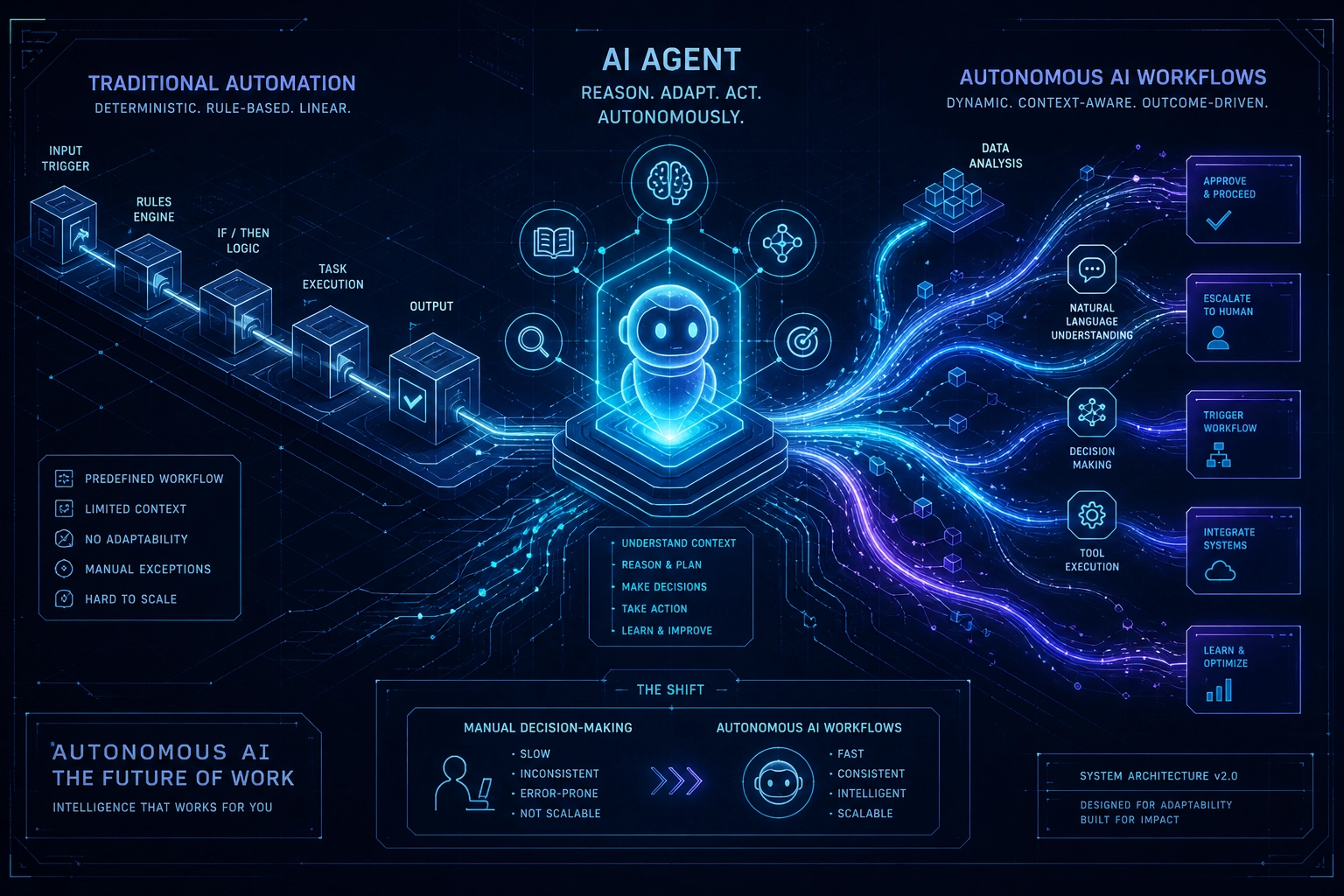
Most conversations about AI agents start in the wrong place. They begin with capability claims, vendor demos, and abstract promises about autonomous systems that will transform how businesses operate. What they rarely provide is a clear, operational answer to a fundamental question: what is an AI agent, and how does it actually function inside a real workflow?
The AI agent definition that matters for business leaders and technical teams is not the one pulled from a research paper. It is the one that explains what these systems perceive, how they reason, what actions they execute, and where human oversight fits into the picture. Understanding that distinction is the difference between deploying something useful and spending months chasing architecture that was never right for the problem.
This analysis cuts through the noise. You will learn how agents differ from chatbots, copilots, and traditional automation; how the PRAL Loop and ReAct pattern drive autonomous decision-making; when deterministic workflows are the smarter architectural choice; and how multi-agent systems, governance requirements, and platform selection come together in production deployments. By the end, you will have a clear framework for deciding whether an AI agent belongs in your stack, and exactly where to start.
What an AI Agent Actually Is (And What It Is Not)
An AI agent is a system that perceives inputs from its environment, reasons over that context, selects and executes actions across integrated tools, and updates its behavior based on outcomes, without waiting for human approval at each step. That loop, perceive, reason, act, learn, is what separates a genuine agent from the swarm of products currently borrowing the label.
The distinctions matter operationally.
Chatbots are reactive and single-turn: they respond to what you send them, then stop. Co-pilots are advisory and human-initiated: they surface a suggestion, but you decide whether to act. Neither initiates action, neither completes multi-step tasks without you in the loop at every inflection point. An agent does both. It receives a trigger, constructs a reasoning path from available tools, executes a sequence of actions, and hands off to a human only when a defined condition is met.
Traditional rule-based automation is different in a subtler but equally important way. A Zapier workflow or a scripted integration follows a fixed logic path: if X, then Y, always. It cannot interpret ambiguous context or select a different path when conditions fall outside its script. An agent evaluates context dynamically and chooses its own route through available tools based on what the current situation actually requires. Peer-reviewed research on agent architectures confirms that this capacity for goal-directed planning across variable conditions is a defining characteristic, not a marketing feature.
Vendor marketing has aggressively diluted the term. The practical test is simple: if the system cannot make a decision and execute an action without you clicking approve, it is not an agent. It is an assisted workflow with a branding upgrade.
Here is what a real agent looks like in practice. An inbound lead arrives. The agent scores it against your qualification criteria, logs it to your CRM, enrolls the contact in the appropriate follow-up sequence, and routes it to a sales rep only when the lead score clears a threshold you defined. No notification waiting for your response. No manual data entry. No step that stalls because you were in a meeting.
That is the operational definition. Everything else in this piece builds from it.
The Architecture Behind Autonomous Decision-Making: The PRAL Loop
Understanding why agents behave autonomously requires looking at the underlying architecture that makes it possible.
An AI agent operates through four sequential phases. Perceive: the agent ingests inputs from email, web forms, APIs, databases, or webhooks. Reason: it evaluates that context against its available tools and selects the appropriate next action. Act: it executes across integrated systems without waiting for approval. Learn: it updates its behavior based on outcomes, flagging edge cases, reinforcing successful resolution paths, or routing unresolved situations for human review.
These four phases are not a rigid pipeline executed once. They cycle continuously throughout a task.
The ReAct Pattern: Think, Act, Repeat
The cognitive engine driving this cycle is the ReAct pattern (Reasoning + Acting), a design pattern where agents alternate between reasoning through a problem and taking an incremental action, then reasoning again based on what that action returned. Critically, the agent does not plan the full sequence upfront. It reasons one step at a time, using each result to inform the next decision. This is what separates an agent from a workflow: the path is constructed dynamically, not prescribed in advance.
This also explains why agents don't require a pre-mapped decision tree. Given a tool registry and current context, the agent determines its own reasoning path. Add a new tool, and the agent can immediately incorporate it. That flexibility is structurally impossible in traditional automation.
A Concrete Example
A customer support agent perceives an inbound ticket. It reasons whether the issue matches known resolution patterns in its knowledge base. It acts by retrieving the relevant documentation and drafting a response. If the resolution is successful, that path is reinforced. If the ticket remains unresolved, the agent learns by flagging it for human review, improving future routing.
Agents vs. Workflows: A Fundamental Architectural Difference
A deterministic workflow executes a predefined graph: step A triggers step B, every time, regardless of context. An agent reasons its way to an outcome, selecting actions based on what the current situation actually requires. One enforces a fixed script; the other interprets the situation and responds accordingly. This distinction determines every architectural and deployment decision that follows.
AI Agents vs. Deterministic Workflows: Why 95% of Production Systems Choose Workflows
Understanding that architecture is the right starting point clarifies the most important practical question: when should you actually use one over the other?
Here is the honest answer. Roughly 95% of production AI systems currently run on deterministic workflows, not fully autonomous agents. That is not a failure of ambition. It reflects a sound engineering reality: most business processes require predictable, auditable execution above all else.
Deterministic workflows execute fixed logic paths identically every time. Invoice generation, data syncs between systems, appointment confirmations, SLA notifications, these processes carry zero tolerance for variability. Introducing an agent that reasons its way through each execution does not improve them; it introduces unnecessary risk. For these use cases, a well-built deterministic workflow will reduce errors and improve consistency far more reliably than any autonomous system.
Agents earn their architectural overhead in a different class of problem: unstructured inputs, ambiguous decision points, and processes where the optimal path genuinely varies by context. A customer escalation that could mean a refund, a replacement, a callback, or an account credit depending on customer history, product type, and tone requires reasoning, not a decision tree. That is where autonomous decision-making pays off.
The framing that matters most is this: choosing between agents and workflows is an engineering decision, not a capability debate. The relevant variables are tolerance for variability, auditability requirements, and failure recovery complexity. If a process must produce an identical output for identical inputs and leave a clean audit trail, build a workflow. If the optimal output depends on context that cannot be fully pre-specified, an agent is the right tool.
Treating this as either/or is the most common architectural mistake. Mature production systems use a hybrid model: deterministic workflows handle the predictable, repeatable steps, while agents manage exception logic and dynamic routing at the edges. The workflow handles the rule; the agent handles everything the rule did not anticipate.
Human-in-the-Loop: How Real Agent Systems Preserve Oversight Without Killing Automation
That hybrid model raises an immediate governance question: if agents handle dynamic decision logic, what stops them from taking an action your business can't defend?
The answer is Human-in-the-Loop architecture, and it is less about limiting agents than about deploying them responsibly.
HITL in practice means agents operate autonomously within predefined boundaries, but escalate to a human when a decision crosses a defined confidence threshold or risk level. The agent doesn't stop working; it pauses a specific action, routes it to a review queue, and continues processing everything else. Autonomy and oversight coexist in the same process.
Pure autonomy is the wrong target for most business contexts. Compliance obligations, legal liability, and brand risk all require that consequential decisions leave a traceable record. Regulated industries, including financial services, healthcare, and pharmaceuticals, require documented evidence of who or what made a decision and why. An agent operating without escalation paths and audit logs isn't efficient; it's ungovernable.
Durable workflows address a separate but related reliability requirement. Long-running agent processes face real-world interruptions: API timeouts, service failures, network errors. Without state persistence, a failure mid-process means restarting from scratch. Durable execution preserves the agent's state across failures and retries, so a workflow that approves a contract or processes a refund completes correctly even if a downstream service hiccups. This is a non-negotiable requirement for enterprise deployments, not an optional enhancement.
Practical HITL design follows three patterns:
Approval gates block high-value or irreversible actions, such as issuing a refund or sending a signed contract, until a human explicitly authorizes them
Exception queues route low-confidence decisions out of the automated path for human review without blocking the rest of the pipeline
Audit logs record the input, the reasoning path, the tool invoked, and the outcome for every agent action, satisfying both internal governance and external regulatory requirements
The business case is straightforward. A fully autonomous agent can only be deployed in processes where every outcome is acceptable without review. HITL removes that constraint. Operators can extend agents into regulated, high-stakes, or customer-facing workflows that would otherwise require permanent human coverage, significantly expanding where agents deliver value without introducing unacceptable risk.
Inside the Stack: Core Components of a Production AI Agent
Understanding why HITL checkpoints exist is straightforward. Understanding where they live inside the agent's physical architecture is a different question entirely.
A production AI agent is not a monolithic program. It is five discrete, modular layers, each with a specific job.
The input perception layer ingests signals from the outside world: form submissions, webhooks, inbound emails, API callbacks, database triggers. This is the agent's sensory surface. What it can perceive is defined at build time.
The reasoning engine is the LLM or decision model that interprets those inputs, evaluates context, and selects the next action. It is the thinking component, not the whole system. As AI agent architecture research from IIT Kanpur notes, separating reasoning from execution is what makes agents modular and auditable.
The tool registry defines every action the agent is permitted to take: send an email, update a CRM record, query a database, trigger a downstream workflow. Agents can only act through tools they have been explicitly granted. This access boundary is both a security control and the primary integration surface with your existing stack. An agent with no CRM tool cannot touch your CRM, regardless of what it reasons.
The memory layer separates functional agents from brittle ones. A stateless agent forgets every session the moment it ends, producing incoherent behavior across multi-step business processes. Persistent memory, storing CRM records, conversation history, and prior decisions, allows the agent to maintain context across sessions and build on previous outcomes. Systems built on enterprise-grade cloud infrastructure, including solutions like those built on Microsoft 365 and AI, treat memory persistence as a core architectural requirement, not an afterthought.
The orchestration layer is the control plane. It sequences steps, manages retry logic, enforces timeouts, and routes to a human when confidence thresholds or risk conditions are met. It decides when to call the reasoning engine, when to execute a tool directly, and when to pause.
Building and maintaining these five layers from scratch carries substantial engineering overhead. That is precisely why purpose-built AI agent frameworks and platforms exist: they abstract the orchestration logic, memory management, and tool-calling infrastructure so teams can focus on process design rather than infrastructure.
Multi-Agent Systems: When One Agent Is Not Enough
That modular stack described in the previous section scales effectively for single-domain tasks. When a process spans multiple domains, tools, and reasoning contexts simultaneously, a single agent becomes the bottleneck.
Multi-agent orchestration solves this by introducing an orchestrator: a coordinating agent that decomposes a complex task and delegates discrete subtasks to specialized sub-agents. Each sub-agent operates with its own tool registry and a tightly scoped reasoning context. The orchestrator manages sequencing, state handoffs, and failure recovery without requiring a human to move work between stages.
Why Single-Agent Systems Hit a Ceiling
Generalist agents degrade under complexity. Three failure modes appear consistently in practice. First, context window saturation: loading every relevant tool, instruction, and conversation thread into a single reasoning context pushes against hard token limits and degrades output quality. Second, tool overload: an agent with 40 available tools reasons less reliably than one with 6, because the selection space introduces ambiguity. Third, reliability tradeoffs: a specialist agent scoped to one function fails clearly and predictably; a generalist fails in ways that are harder to diagnose and recover from.
A Production Example: Sales Pipeline
Consider an end-to-end sales pipeline built on four specialized agents. An intake agent receives a new inbound lead, scores it against qualification criteria, and logs it to the CRM. A research agent enriches the contact record with firmographic data. A communication agent generates a personalized outreach sequence calibrated to the prospect's profile. An escalation agent monitors engagement signals and routes high-value prospects directly to a sales rep. No human sequences these handoffs. Each agent does one thing well and passes a structured output to the next.
Event-Driven Coordination
These agents don't call each other directly. They communicate through shared event streams, publishing completion signals or exception flags that downstream agents subscribe to. This loose coupling means you can debug, replace, or extend any single agent without touching the others, a critical property in production systems that evolve over time.
Per peer-reviewed research on multi-agent enterprise architectures, standardized protocols including Model Context Protocol (MCP) now formalize agent-to-orchestrator communication, confirming that multi-agent orchestration has moved from academic concept to production deployment pattern across banking, software engineering, and cross-industry workflows in 2025 and 2026.
Where AI Agents Deliver Real ROI: Business Processes Worth Automating
Architecture explains how agents work. Business case determines whether they should.
The decision to deploy an agent over a deterministic workflow comes down to four conditions: unstructured inputs, variable decision paths, cross-tool coordination, and meaningful human time cost per instance. When all four are present, agent complexity pays for itself. When even one is missing, a simpler workflow almost always wins.
Where Agents Earn Their Complexity
The highest-ROI use cases share a common profile: a human is currently reading, interpreting, and routing something, then logging that decision across multiple tools.
Inbound lead qualification and routing: Agents score leads from unstructured form submissions, cross-reference CRM history, and trigger personalized follow-up sequences. Documented deployments show 30-50% conversion rate improvements without adding headcount.
Customer support triage and first-response resolution: Agents classify tickets, pull from knowledge bases, and resolve 60-80% of L1 requests before a human sees them. First response time drops from hours to seconds.
Contract review and approval workflows: Agents flag clause deviations, route for approval, and track status across stakeholders. Review cycles run up to 10x faster.
Invoice exception handling: Agents investigate discrepancies, cross-reference purchase orders, and escalate only genuine exceptions. Typical result: 1-2 FTE freed within six months.
Onboarding sequence management: Agents coordinate multi-step onboarding across CRM, communication, and project tools, compressing a two-day process to under 30 minutes.
Where Deterministic Workflows Should Stay
Scheduled data syncs, payment confirmations, SLA notifications, and compliance audit logging should remain deterministic. These processes require identical execution every time. Variability is a defect, not a feature, and auditability requirements favor fixed, traceable logic over adaptive reasoning.
Quantifying the Return
Agents compound ROI through three mechanisms: eliminating decision latency, reducing errors from manual data handling, and delivering 24/7 coverage without headcount scaling. Early adopters report returns between 1.7x and 10x per dollar invested.
Integration Economics
The strongest ROI argument is not the first use case; it is the second and third. Agents built on your existing CRM, project management, and communication stack amortize implementation cost across every process they touch. Tool integrations, memory configuration, and decision logic built for lead routing can be extended to triage or onboarding at marginal incremental cost. You can explore Featured Projects to see how this compounding logic applies across real business deployments spanning CRM automation, lead workflows, and cross-platform orchestration.
The value proposition is not replacing your stack. It is orchestrating what you already have with a reasoning layer that eliminates the manual decisions sitting between your tools.
Choosing an AI Agent Builder or Platform: What to Evaluate
Once you've identified agent-ready processes and understand the ROI case, the next decision is build approach: which platform, framework, or implementation model actually gets you to production.
Five criteria separate capable platforms from ones that create problems downstream:
Native integrations with your existing CRM, communication stack, and data sources. An agent that requires custom connectors for every tool adds engineering overhead before the first workflow runs.
HITL configuration that lets you define escalation triggers at the platform level, not hard-coded into individual agents.
Durable workflow support, meaning long-running processes survive failures and resume from their last confirmed state rather than restarting from scratch.
Observability and audit logging baked in, not bolted on. Every action an agent takes should be traceable to the input that triggered it.
Escalation path design that routes exceptions cleanly to human reviewers without breaking the automated flow around them.
On the open-source versus proprietary decision: open-source AI agent frameworks give you full control over architecture and avoid vendor lock-in, but they require dedicated engineering capacity to configure, maintain, and extend. Proprietary platforms compress time-to-value significantly, with tradeoffs in customization ceiling and long-term licensing cost. Neither is universally correct; the right choice depends on your internal engineering resources and how much workflow-specific customization your processes require.
Platform lock-in deserves serious evaluation before you commit. Switching costs in agentic systems are substantially higher than in traditional automation because the reasoning layer, memory store, tool registry, and orchestration logic are tightly coupled. Assess whether each of those components can be migrated independently if your requirements change.
Off-the-shelf agents are optimized for general tasks. A generic support agent does not know your escalation thresholds, your CRM field structure, or your product-specific resolution logic. Custom agents built to your process topology outperform them because the scope, data access, and decision boundaries are defined precisely for your operation.
At Automation by Meir, every agent build starts from your specific workflow topology. We integrate with your existing CRM and communication stack rather than replacing it, and we design HITL checkpoints that preserve your oversight without adding approval friction to steps that don't need it. You can review the range of solutions we've built to see how this approach translates across different business contexts.
Risk, Compliance, and Governance in Autonomous Agent Deployments
Choosing the right platform is only part of the deployment equation. Once an agent is live and acting on behalf of your business, governance determines whether that autonomy is an asset or a liability.
Autonomous agents create liability exposure that chatbots and co-pilots do not. When a system sends an email, modifies a CRM record, or triggers a payment action without human approval at each step, your business is accountable for every one of those actions. If an agent takes an incorrect action and you cannot produce a traceable record of why it did so, you have both an operational problem and a legal one.
Audit logging is a hard engineering requirement, not a reporting nicety. Every agent action should be logged with four elements: the input that triggered it, the reasoning path selected, the tool invoked, and the outcome. A 2026 survey of 235 large-enterprise CISOs and CIOs found that 92% lack full visibility into their AI agent identities, and 95% doubt they could detect or contain a compromised agent. That visibility gap is a logging gap. OWASP's Agent Control Standard establishes audit trail protocols as a foundational control category, and any production deployment that skips this creates unrecoverable blind spots.
Scope containment is your primary safety mechanism. Agents should be granted the minimum tool access required for their specific task, nothing more. An agent that handles invoice exceptions has no legitimate reason to access your HR database. Overly broad permissions are not just a security risk; they expand the blast radius of any error the agent makes.
Regulated industries require compliance by design, not by retrofit. Financial services, healthcare, and legal workflows carry specific obligations: data residency rules, consent management, and approval documentation that must be wired into the agent architecture before the first production run. Adding these controls after deployment is expensive and frequently incomplete.
This is the practical argument for working with an experienced implementation partner. Building agent governance from scratch under time pressure produces agents with insufficient logging, permissions scoped too broadly, and no defined fallback when confidence drops. Getting that architecture right before deployment is substantially cheaper than remediating it after an incident.
Moving from Hype to Implementation: What to Do Next
With governance architecture in place, the path from concept to production becomes a sequencing problem, not a capability question.
The core argument throughout this piece stands as written: AI agents are operational systems defined by their ability to perceive inputs, reason over context, act across integrated tools, and update behavior based on outcomes. They are not chatbots, not co-pilots, and not universal replacements for the deterministic workflows already running reliably in your stack.
The practical starting point is narrow by design. Identify one process, not ten. Look for three characteristics: unstructured inputs that arrive in variable formats, decision logic that changes based on context, and meaningful human time cost per instance. Inbound lead qualification, support ticket triage, and invoice exception handling repeatedly surface as strong first candidates because they satisfy all three criteria. That single process becomes your proof of concept and your internal reference architecture.
Carry one architectural principle forward: design for the spectrum, not the binary. The 95% of production systems that choose deterministic workflows are not avoiding agents out of ignorance; they are preserving auditability where it matters most. The mature pattern combines fixed workflow steps for predictable process segments with agent-driven logic for exception handling and dynamic routing. That hybrid is not a compromise; it is the correct architecture for most business environments.
Before any deployment, lock down four governance items:
Tool scope: which systems the agent can access and act on
Escalation triggers: the conditions that route decisions to a human
Audit logging: every input, reasoning step, tool call, and outcome recorded
Failure recovery: defined behavior when the agent hits an error or low-confidence state
These are not optional refinements added after launch. They are prerequisites.
The next step is an honest audit of your current automation stack. Map your processes against the agent-ready profile above, identify the strongest candidate, and define the governance baseline before writing a single line of configuration. If you are ready to move from assessment to a working system, view engagement and pricing details for a scoped implementation built around your specific workflow, stack, and compliance requirements.
Conclusion
AI agents are powerful, but they are not a universal solution. The organizations extracting real value from autonomous AI share three traits: they match the tool to the task, they build governance in from the start, and they treat hybrid architectures as a feature rather than a fallback.
The core takeaways from this guide are straightforward. Agents solve problems that require dynamic reasoning; workflows solve problems that require reliability and auditability. Most production systems need both. And no autonomous deployment is ready until tool scope, escalation logic, audit logging, and failure recovery are defined.
The opportunity is real, and the implementation path is clearer than most teams expect. Start with your strongest candidate process, establish your governance baseline, and build from there. Practical automation compounds quickly when the foundation is correct.